A product designer approves a promising new component on Monday. By Friday, the manufacturing team has already discovered a problem: the shape may become trapped inside the tool, the cooling route is inefficient, and the first physical prototype will cost more than expected. In traditional workflows, such a discovery can trigger another round of drawings, machining and delays. Modern digital manufacturing aims to identify those issues much earlier.
That change matters because manufacturers face shorter product cycles, rising customer expectations and little room for costly trial and error. Quality must still remain consistent, whether a workshop is producing ten parts or ten thousand.
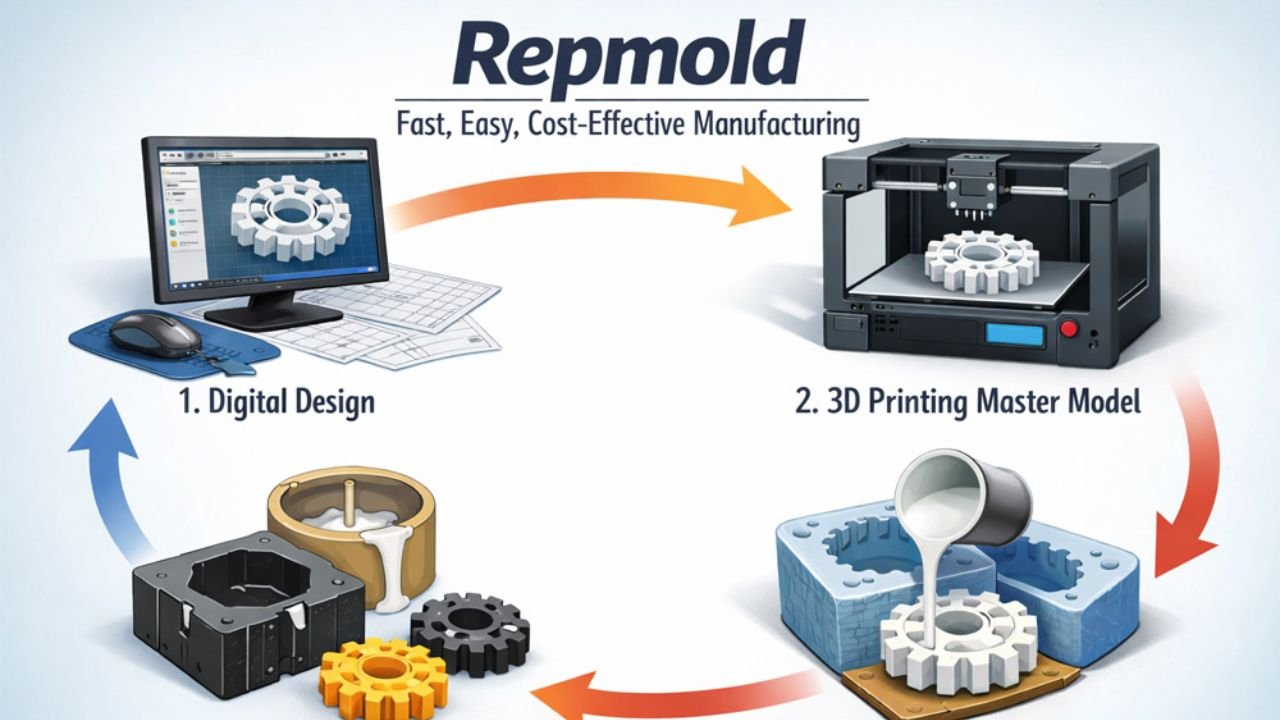
This is the setting in which Repmold has started attracting online attention. The term is generally used to describe a digitally connected approach to replication and mould production rather than one universally standardised machine or process. It brings familiar technologies such as computer-aided design, simulation, rapid tooling, additive manufacturing and CNC machining into a more flexible workflow built around repeatability.
What Does Repmold Actually Mean?
The name appears to combine the ideas of “replication” and “moulding”. In practical discussions, it often refers to the creation, reproduction or improvement of moulds through digital design and modern production techniques. Its meaning varies: it may describe a workflow, a manufacturing concept or a broad label for faster mould replication rather than a formal engineering standard.
The idea begins with a digital model. Engineers define the component, its dimensions and its production route, then assess details such as wall thickness, draft angles, material flow, cooling and likely deformation. A prototype tool, mould insert, pattern or production mould can then be made.
That does not mean every mould is 3D printed or every decision is made by artificial intelligence. Some tools are additively manufactured; others are cut from aluminium or steel using CNC equipment. A team might print an early prototype, machine a stronger trial tool and invest in hardened tooling once demand is proven.
This makes the concept less mysterious than some descriptions suggest. It is best understood as an organised digital route from a product idea to repeatable physical output.
It can also include the replication of an existing component. When original design files are unavailable, engineers may use three-dimensional scanning, careful measurement and reverse engineering to build a new digital model. That model can then be corrected, improved or adapted before a replacement mould is produced.
However, replication does not always mean creating an exact copy. An older component may contain weaknesses, outdated materials or features that are difficult to manufacture. A modern workflow allows those issues to be reviewed rather than repeated automatically.
How the Digital Mould-Making Workflow Operates
A project starts with requirements: the part’s purpose, operating conditions, expected volume, tolerance and material. A consumer casing creates different tooling demands from a heat-resistant engineering component.
CAD software then allows the product and mould geometry to be created, reviewed and revised. Designers can inspect a three-dimensional model, consider how the part will leave the mould and plan split lines, gates, runners, vents and ejector positions before metal is cut.
Simulation may follow. For injection-moulded components, software can help a team examine how material is likely to fill the cavity, where air could become trapped and whether uneven cooling may cause warping. Simulation does not remove the need for practical expertise, but it can expose avoidable weaknesses before they become expensive physical mistakes.
The tool is then produced through the most suitable route. Rapid prototypes may use polymer printing, resin-based processes or printed patterns. Short-run tools may be made from softer metals or specialist composites. Higher-volume production usually demands tougher materials, accurate machining and a carefully controlled finish.
The completed tool is tested by producing sample parts. These pieces are not simply checked to see whether they look correct. Measurements, wall thickness, surface quality, assembly fit and functional performance may all need to be inspected.
Any problems can then be fed back into the digital model. A gate position may be adjusted, a cooling channel redesigned or a troublesome corner softened. This closed loop design, test, learn and refine is central to the Repmold idea.
Digital records are another important part of the process. When files, settings, revisions and inspection results are stored properly, teams can understand why a particular version succeeded or failed. They are less likely to depend on handwritten notes, memory or information held by one employee.
Why Manufacturers Are Paying Attention
Speed is one of the strongest attractions. When designs can be reviewed and amended digitally, teams may avoid waiting until a finished tool reveals a basic fault. Earlier feedback can shorten the journey from concept to a testable part, especially during product development.
Flexibility is equally valuable. A small design change can be disruptive when it requires a tool to be rebuilt from scratch. A digitally managed process makes revisions easier to document and communicate. It can also support product families in which several versions share a common base but require different details.
Repeatability is another major consideration. Digital records preserve dimensions, process settings and inspection information, helping teams investigate variation and reproduce successful results.
There may also be environmental benefits, although they should not be exaggerated. Better simulation can reduce failed trials, while additive methods can use material differently from subtractive machining. However, the overall impact depends on the material, energy source, production volume, tool life and end-of-life plan. A printed tool is not automatically greener simply because it is modern.
For smaller manufacturers, the appeal often comes from risk reduction. Prototypes or short runs can test demand before a business commits to expensive long-life tooling.
Consider a small company developing a new household product. Ordering a hardened production mould before testing the design could tie up a substantial amount of money. A digitally managed prototype and short-run process may reveal whether customers like the shape, whether the parts assemble correctly and whether the product performs as expected.
The business can then refine the design before scaling production. This staged approach does not remove commercial risk, but it can prevent a company from investing heavily in a product that still needs basic improvements.
Where the Approach Can Support UK Industry
Britain has a broad manufacturing base that includes automotive suppliers, aerospace businesses, medical technology companies, packaging producers and specialist engineering firms. Each sector has different regulations and quality expectations, but many share a need for accurate components and shorter development cycles.
In automotive work, digitally developed moulds can support interior trim, housings, clips, seals and prototype components. The industry frequently manages model updates and multiple product variants, so controlled design changes are especially useful. Still, safety-related parts require proper validation; a faster workflow cannot replace testing or traceability.
Medical manufacturing can benefit from precision and consistency, particularly for device housings, laboratory components and certain disposable products. Yet this is also an area where casual claims should be avoided. Material suitability, cleanliness, process validation and regulatory requirements must be addressed before any component reaches clinical use.
Consumer-product businesses may use rapid tooling to test appearance, grip, assembly and customer response. A kitchen accessory or electronics enclosure can be refined through several iterations before the final tool is commissioned. This helps the finished item feel deliberate rather than rushed.
Aerospace and defence applications may also use advanced tooling, printed patterns and digitally controlled production, particularly for prototypes, composites and low-volume specialist parts. The standards are demanding, and documentation can be as important as geometry. The benefit comes from a controlled digital thread, not simply from producing a part quickly.
Packaging is another relevant area. Brands regularly introduce new container shapes, closures and limited product ranges. Digital design and prototype tooling can help teams assess appearance, wall thickness and usability before committing to a long production run.
The same principles can support heritage and maintenance projects. Scanning and reverse engineering may recreate a pattern or tool for a difficult-to-source part, although ownership and safety issues still require checking.
This may be useful when machinery remains operational but the original manufacturer no longer supplies a particular cover, handle, bracket or housing. Recreating the component responsibly can extend equipment life, but the replacement still needs to meet the correct functional and safety requirements.
Practical Benefits, Limits and Buying Questions
The strongest case for Repmold appears when a project needs design iteration, customised geometry, lower-volume production or a shorter route to testing. It may be less persuasive when a stable product already has reliable high-volume tooling and no meaningful need for change.
Cost needs careful examination. Software, scanners, printers, CNC machines and skilled staff require investment. Buyers should compare the full project cost, including inspection, finishing, maintenance, redesign and expected tool life.
Material limitations matter as well. A prototype mould may perform well for a small number of cycles but fail under the heat, pressure or abrasion of continuous production. Surface finish can also differ between printed, cast and machined tools. The chosen method must suit the polymer, metal, composite or ceramic being processed.
Accuracy should never be assumed. A supplier may advertise impressive machine tolerances, but the finished result can also be affected by material shrinkage, temperature control, tool wear, post-processing and inspection methods. The relevant question is whether the complete process can meet the component’s actual specification.
Cybersecurity and intellectual property deserve attention because digital manufacturing depends on valuable design files. Businesses should ask how files are stored, who can access them, whether versions are controlled and what happens to data after a supplier relationship ends.
Before choosing a provider, a buyer should request evidence rather than broad promises. Useful questions include:
- What production volume is the tool designed to handle?
- Which materials and tolerances can the process support?
- How will the mould and sample parts be inspected?
- What design changes are included in the quotation?
- Who owns the CAD files, tooling data and finished mould?
- What happens if trial parts fail the agreed specification?
The future is likely to bring more automation, better simulation, improved monitoring and wider use of digital twins. Artificial intelligence may assist with design, defect detection and maintenance planning, but human engineering judgement will remain essential.
Frequently Asked Questions
Is Repmold a specific machine or brand?
Not necessarily. The term is used online in several ways, but it commonly describes a modern approach to mould replication and production that connects digital design with manufacturing tools. Buyers should ask a supplier exactly what process is being offered.
Is it the same as 3D printing?
No. Three-dimensional printing may be one part of the workflow, especially for prototypes, patterns or inserts. A final mould may instead be CNC-machined, cast or produced through a hybrid process.
Can it replace traditional mould-making?
It can improve or accelerate parts of traditional mould-making, but it does not make established tooling methods obsolete. Hardened steel tools may remain the better choice for long, high-volume production runs.
Is it suitable for small UK businesses?
It can be, particularly when a business needs prototypes, short runs or evidence of demand before investing in full production tooling. The commercial case depends on volume, material, quality requirements and available expertise.
What is the biggest risk?
The biggest risk is treating a fashionable label as a guarantee. A successful project still depends on sound design, realistic material selection, accurate inspection, skilled manufacturing and clear ownership of technical data.
conculsion
The lasting value of Repmold will not come from the name itself. It will come from the practical discipline behind it: testing ideas digitally, selecting the right production method and learning from reliable data before committing to scale. For UK manufacturers facing pressure to move faster without sacrificing quality, that balanced approach offers more than hype. It offers a sensible way to make mould development more informed, adaptable and commercially controlled.