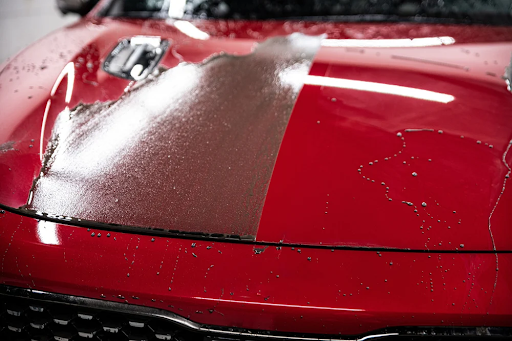
Nowadays, the owners of cars are much concerned with the issue of protecting paint because they understand that it is not only important to have shiny paint but also to preserve the original state of paint, avoid having to repaint, and keep the resale value. With time, ceramic coating was in trend, followed by a better version: graphene coating. Currently, there has emerged another new product that deserves special attention from detailers: borophene coating.
It created the debate on borophene vs. graphene, where everyone, including car owners, asks the very same question: Which coating provides better protection? Although these are two advanced options, borophene coating is chosen more often due to its increased durability and longevity.
What Is Graphene Coating?
In order to compare these two kinds of coating, it is necessary to talk about the functions of graphene coating first.
Graphene coating is recognized as an advanced variant of ceramic coating. Its main function is the formation of a protective film over the paint of the car to prevent such effects as ultraviolet rays, oxidation processes, bird droppings, water spots, and staining from chemicals.
It enhances gloss and produces hydrophobicity, meaning that water can bead up easily and the cleaning process becomes easier. For years, graphene was considered one of the most advanced materials for car paint protection.
However, borophene coating is altering this narrative.
Why Is Borophene Special?
Borophene is an emerging technological innovation providing superior surface performance. To be exact, it is an innovative product intended to produce a more robust and more durable protective film than graphene.
First-class borophene coating provides protection from minor scuffs, swirls, oxidation, ultraviolet rays, bird dropping, and chemical staining. Like graphene coating, it enhances gloss and smoothness. However, the most remarkable feature of borophene coating is its increased durability.
The bonding between the coating and the paint surface is stronger. Therefore, the protective film lasts longer and functions better during adverse environmental conditions.
Comparison of Borophene vs Graphene: Scratch Resistance
Among the many distinguishing factors when comparing borophene vs graphene, scratch resistance plays a major role.
The graphene coating serves well as an effective surface protector, but it only protects the surface in a limited way. It can resist small swirl marks and stains, but it cannot prevent small abrasions effectively.
On the other hand, the borophene coating gives better hardness to the surface, thereby preventing scratches easily. While it does not replace paint protection film for physical impact protection, it performs better than graphene when it comes to maintaining surface quality during regular use.
For daily-driven cars, this difference becomes noticeable over time.
Better Durability in Harsh Conditions
The Indian environment and road condition can pose challenges for any type of car coating material. There will be dust accumulation, pollution, strong sunshine, rainfall, bird droppings, and constant washing activities that may affect the effectiveness of the coating process.
Graphene coating will offer excellent thermal stability and hydrophobicity, but borophene coating will provide higher durability and longevity of the coating process when compared with graphene. This coating will have the ability to withstand the effects of the environment for a much longer period of time without needing frequent application.
It will make borophene coating an ideal choice for car owners who want to reduce the frequency of application.
Comparison of Shine and Finish
Both types of coating materials will add shine to your vehicle. However, both of them have different approaches to adding shine to the car.
Graphene coating will provide a highly glossy and reflective finish. It is highly appreciated by car owners due to the hydrophobic properties of the material.
On the other hand, borophene coating will not be able to create a hydrophobic finish on your car. The material will provide a clearer and deeper finish to the car.
Maintenance and Practical Value
Borophene coating can also be considered highly advantageous when it comes to maintenance.
As it forms a more durable surface, it does not attract dust or dirt that easily. Thus, the cleaning process becomes much easier, and you do not need to perform polishing or corrections as frequently.
Graphene coating also provides you with easy cleaning, but eventually, its hydrophobic properties might start to deteriorate sooner than in the case of the more durable borophene layer.
If you wish to minimize the amount of maintenance required and provide your car with long-lasting protection, choosing the latter seems like a wise decision.
Is Borophene Coating Replacing Graphene?
While graphene coating continues to offer excellent results for those seeking an additional level of protection besides ceramic coating, borophene coating is definitely emerging as an intriguing alternative.
In a comparison between borophene vs. graphene coating, it is important to understand how the latter performs in reality. It feels less like a trend and more like the next step in coating technology.
Conclusion
The discussion around borophene vs. graphene is not about one being bad and the other being perfect. Both are strong paint protection solutions, and both are far better than basic waxing or polishing.
But for car owners who want stronger durability, better scratch resistance, improved long-term finish, and reduced maintenance, borophene coating is clearly becoming the stronger choice.
With the advancement of technology in the field of car detailing, the use of borophene coating in paint protection will definitely be more effective than the currently popular graphene.